
Why reading matters
(The importance of reading and writing to process your emotions.)

I grew up in a dysfunctional family. There was domestic violence, drug and alcohol use, and abandonment.
To cope with what was happening around me, I turned to creativity.
I liked to read and write.
If it weren’t for those two things, I really don’t think I would be here today.
Reading allowed me to escape to fantasy worlds or to possible far-flung futures.
And as a bonus: Books were easy to come by (they were cheap or I could borrow them from the local library).
When I think back at my childhood, Tolkien, Asimov, and Lucas were some of the major authors that I gravitated toward.
I could pretend that I was in Middle Earth, in Star Wars, or with robots in Asimov’s novels.
What I learned at an early age is that what I think can help me process emotions and emulate how to act. In the Lord of the Rings, Frodo and Sam sacrifice everything to save all they love.
In Star Wars, Luke faces his father and chooses the path of light.
These examples helped me find a path to not repeating the mistakes that I saw the men in my family make.
After my parents divorced, I didn’t see my father for close to twenty years. In my mind, he was only like Darth Vader or Sauron.
I despised him and vowed to do everything I could to not be like him.
But the effects of dysfunction and abuses of drugs/alcohol are multi-generational—those effects were like a hand grenade that affected everyone within the family.
Was this fair?
No, but that’s how it goes.
I’m currently currently Proust and the Squid: The Story and Science of the Reading Brain by Maryanne Wolf. What I find so fascinating is that reading does affect the young mind. Children who are not being read to or have access to books find themselves years behind developmentally by the time they start kindergarten.
And I learned recently that Frederick Douglas kept re-reading The Columbian Orator to help him train his mind and teach him about liberty and justice.
And in my small way, I did the same. I grew up in the world of fantasy and science fiction, so that’s what I read and wrote as a kid.
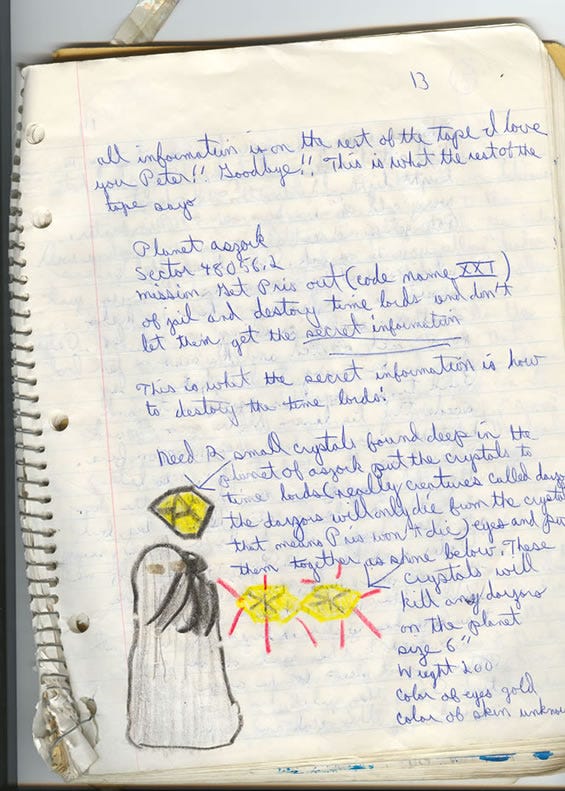
When I was around 9 years old, I wrote my first story, “The Mission,” and I used my limited writing skills to create a world that I could escape. Later, at 16, I wrote my first novel (Dorothea’s Song) and wove in my personal struggles with those of a fantasy world that I had made up.
I couldn’t control the world of adults around me, but I realized at an early age that I could use art, creativity, and my imagination to heal myself.
Reading and writing saved me.
Maybe it has done the same for you?
There are many tools that we can use on our journey toward healing. One of those is the power of the written word.
I share this all with you because I believe in the power of art.
Art (writing) isn’t the only thing that saved me, but it’s one of the most integral tools that I have.
What I read and what I write has affected me deeply in my lifetime.
No matter if it’s my Let Go and Be Free self-help books or my fantasy books, I’ve found them to be gateways to self-care and healing.
So I’ll challenge you: What are you reading or writing? What thoughts/ideas are you allowing to go into your brain?
Be honest: Are you doomscrolling on social media? Or don’t read at all?
I invite you to think outside the box and try something different: Start a journal, read a book, and get in touch with your child-like self.

If you want a break and want to read something written by me that’s more escapist (but still has strong themes of family and healing), you can get the free ebook of Ahab’s Daughter at these online stores:
No matter if you want to try a book of mine or not, I hope you take a moment and reflect on the power of reading and writing and how it could help you in your life.
Thank you.